
Why Schools in India Are Turning to ERP Software
India has over 1.5 million schools. Yet the majority still depend on physical registers, manual roll calls, and handwritten fee receipts to manage critical administrative workflows. The result? Hours of avoidable paperwork, frequent calculation errors, and zero data-driven insight into what is actually happening inside the school.
School ERP (Enterprise Resource Planning) software solves this by digitising every layer of school administration — from student admissions to annual examination report cards — in a single, integrated system.
The Unique Challenges Facing Indian Schools
- Unreliable internet connectivity: Many rural and semi-urban schools in states like Jammu & Kashmir, Himachal Pradesh, and Uttar Pradesh have intermittent internet access. A cloud-only ERP becomes completely unusable on a day with poor network connectivity.
- Multiple exam boards: India operates CBSE, ICSE, state boards (J&K Board, UP Board, Maharashtra SSC), and NIOS simultaneously. Each board has distinct grading patterns, attendance calculations, and report card formats.
- Low digital literacy among staff: Most school teachers are not trained software users. The ERP must be simple enough to operate without any technical training.
- Budget constraints: Private schools in India, especially those in Tier 2 and Tier 3 cities, operate with limited IT budgets. Expensive SaaS subscriptions are often not viable.
How Offline-First School ERP Addresses These Problems
An offline-first ERP stores all data locally on the school's Windows server or desktop computer. The application runs entirely on the school's local Wi-Fi network, so teachers can mark attendance, generate fee receipts, and create report cards even without an active internet connection.
When internet access is available, the system syncs with the cloud automatically — giving school administrators a live backup and remote access without any disruption to daily operations.
Key Features of a Modern School ERP System in India
- Admission Management: Digital student registration, document uploads, and class allocation.
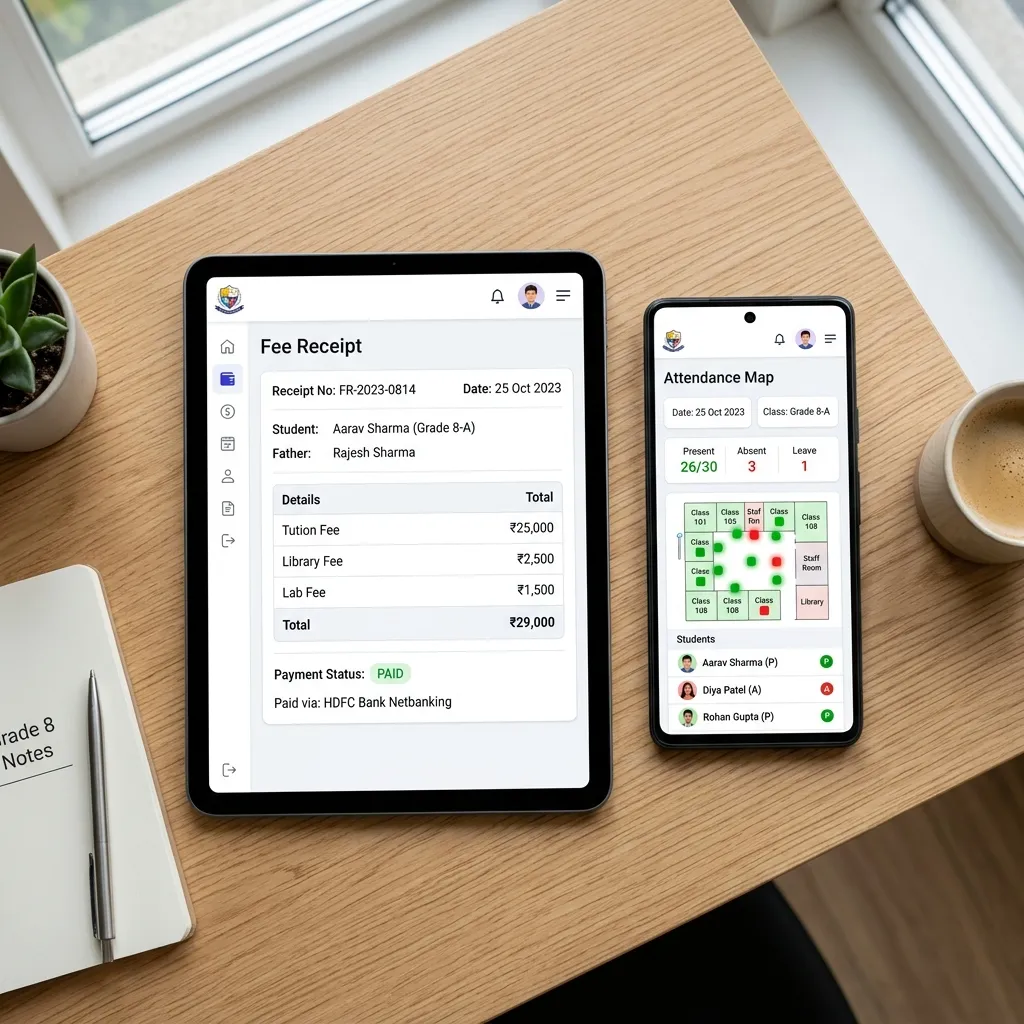
- Fee Collection & Receipts: Instant fee collection with automated receipt printing and balance tracking.
- Attendance Automation: Daily student and teacher attendance with SMS alerts to parents on absence.
- Marks & Report Cards: Board-aligned grade computation with single-click report card PDF generation.
- Certificate Automation: Instant generation of bonafide, date-of-birth, transfer, and identity card certificates.
- Mobile App Integration: Android companion app for teachers to mark attendance and view dashboards remotely.
Real Impact in Indian Schools
Schools that have implemented ERP systems report cutting daily administrative work by 60–70%. Teachers spend more time teaching. Administrators spend less time on paperwork. Parents receive timely SMS notifications. Principals have real-time visibility into attendance, fee collection, and academic performance — all on a single screen.
Conclusion
The growth of school ERP adoption in India is not a trend — it is a structural shift in how educational institutions operate. Schools that digitise their administration today will operate with greater efficiency, transparency, and accountability well into the future.
If you would like to see a live demonstration of an offline-first School ERP built specifically for Indian educational institutions, contact ProSolution Technologies for a free consultation.